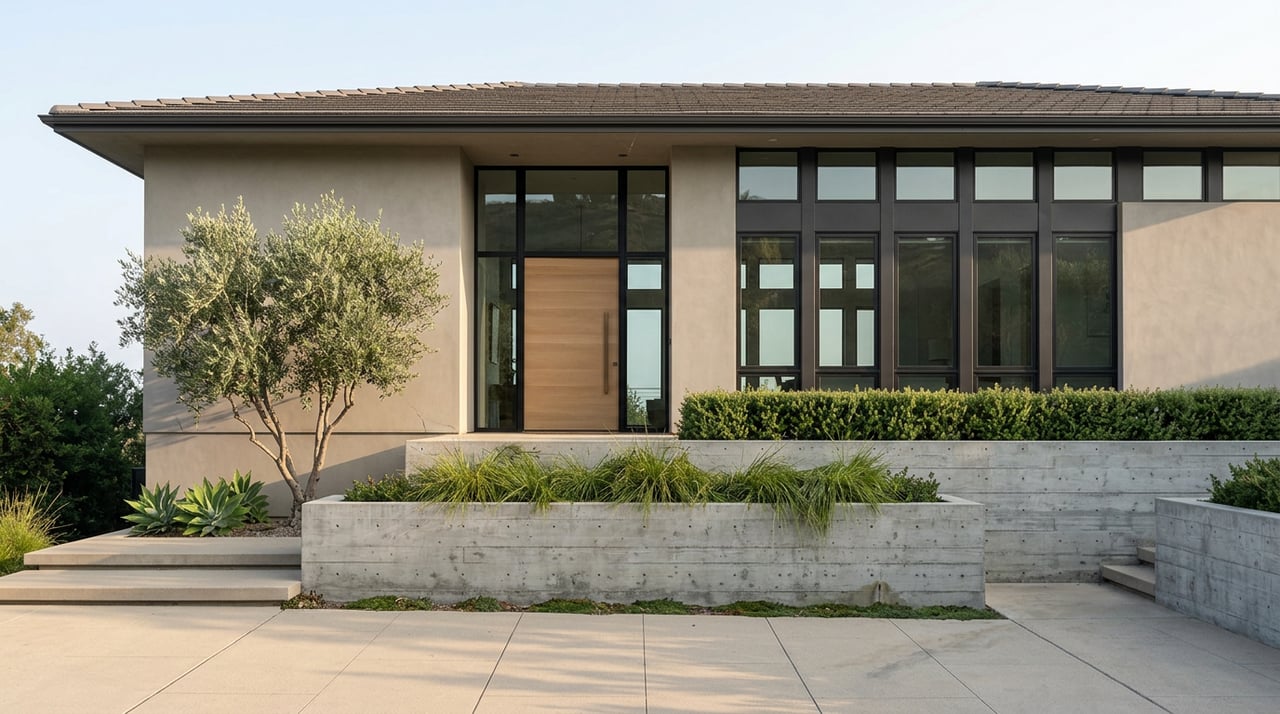
The San Marcos Median Assumes One Market. San Elijo Hills Alone Has Three.
September 10, 2026
September 10, 2026
A family touring San Elijo Hills this month got two very different numbers for what looked like the same neighborhood. Their buyer's agent pulled up a sold-price tracker showing a trailing median around $837,000. An hour later, standing in front of a five-bedroom on Genoa Way listed at $2.5 million, the listing agent pointed out that the community's active detached inventory that week ran from $1,225,000 to that same $2.5 million listing. Same hillside. Same school district. Same zip code, 92078. Two numbers that differ by more than a million dollars.
Neither agent was wrong. They were describing different products wearing the same neighborhood name.
That gap is the reason San Marcos's citywide median price is a poor tool for anyone actually shopping this market. As of September 2026, San Marcos homes carried a median list price of $786,000, down from the same month a year earlier. Looking at closed sales over the three months ending in May 2026, the median sale price across the city was $880,000, down 5.4 percent year over year. Both numbers describe a market that looks like it is softening.
But San Marcos isn't one market. It's a handful of them stitched together under one city boundary, and they are not all moving in the same direction, let alone at the same price point.
San Elijo Hills sits on the highest ground in San Marcos, about eight miles from the coast, developed starting in 2002 out of chaparral and sage scrub into more than two dozen "villages" with names like Atherton, Calistoga, and Woodley's Glen. It is also, depending on which slice of its housing stock you're pricing, three different markets.
At the entry end, attached and older product has pulled the neighborhood's trailing sold-price median down to around $837,000 in recent 2026 tracking. In the middle, detached single-family resales across the community's built-out sections have been running higher: one neighborhood-specific update put the average detached sale price at $1,101,500 in January 2026, while a separate tracker recorded a $1,450,000 median across the same neighborhood by June 2026. At the top, the priciest detached homes for sale push well past either number. A snapshot from September 5, 2026 showed just five detached homes on the market in San Elijo Hills, with asking prices ranging from $1,225,000 to $2,500,000 and a median list price above $2 million.
A buyer who hears "San Elijo Hills is around $837K" and a buyer who hears "San Elijo Hills starts at $1.2 million" are both technically correct. They're just shopping different floors of the same hillside.
If San Elijo Hills illustrates how one neighborhood name can span a wide price range, Twin Oaks Valley Ranch illustrates something else: a newer-built pocket that ignored the citywide cooling trend entirely. Over the three months ending in February 2026, homes in Twin Oaks Valley Ranch sold for a median of $1.1 million, up 13.1 percent from the same period a year earlier. That's a double-digit gain in the same stretch of time the citywide median was sliding.
This matters for anyone leaning on a single headline number to decide whether San Marcos is a buyer's market or a seller's market right now. It's both, depending on the block. A newer-construction pocket like Twin Oaks Valley Ranch can post double-digit appreciation while a few miles away, condo-heavy sections of San Elijo Hills post declines, and the citywide blended number lands somewhere in the middle looking flat to soft. None of the three numbers is fake. All three are incomplete on their own.
| Housing vintage | Recent price signal | Mello-Roos / CFD | |
|---|---|---|---|
| Twin Oaks Valley / Discovery Hills | Mostly late 1970s to 1990s | Twin Oaks Valley average $990K, down roughly 20% YoY in a recent snapshot | Often none |
| San Elijo Hills (attached/entry) | Built starting 2002 | Neighborhood sold median around $837K | CFD present, varies by village |
| San Elijo Hills (detached, mid-tier) | Built 2002 to mid-2010s | $1.1M to $1.5M range through 2026 | CFD present, varies by village |
| San Elijo Hills (Estates, custom) | Newer, larger lots | Active asks $1.2M to $2.5M as of September 2026 | CFD present |
| Twin Oaks Valley Ranch | Newer-built | Median $1.1M, up 13.1% YoY (three months ending Feb 2026) | Varies |
The other variable that gets lost inside a citywide median is the tax bill attached to the address. San Marcos uses Community Facilities Districts, commonly called Mello-Roos, to finance the roads, sidewalks, and utilities that came with its newer master-planned construction. San Elijo Hills sits under one overall district, but the villages within it fall under different sub-districts, which is why fees vary block to block even inside the same community. In Belmont, for example, buyers can expect Mello-Roos in the range of $1,800 a year on top of a base property tax rate around 1.09 percent.
Those obligations aren't static. The city refinanced $20.6 million in San Elijo bonds in 2018, producing roughly $3.9 million in savings spread across 882 property owners in named sub-communities including Saverne, Azure, Cambria, Woodley's Glen, Crest View, Waterford, Village Square, and Westridge. The savings ranged from $120 to $450 a year per household, with condominiums typically taxed at a lower rate than single-family homes. The bonds themselves carry a term that runs into the mid-2030s, which means the tax line on a San Elijo Hills mortgage statement isn't going away soon, but it also isn't fixed in stone.
Compare that to the older tracts. Homes in Discovery Hills and Twin Oaks Valley proper, built largely in the late 1970s through the 1990s around Discovery Lake, are frequently available without any attached Mello-Roos fee at all. That's not a minor line item. A buyer comparing a $950,000 home in Discovery Hills to a similarly priced home in a San Elijo Hills village is not comparing apples to apples once the CFD bill lands, even if the sale price on paper looks identical.
Discovery Lake itself is worth understanding as more than a footnote. It's a five-acre, dammed section of San Marcos Creek with an easy 0.8-mile paved loop around Lakeview Park, a splash pad that runs daily from mid-March through mid-November, and catch-and-release fishing off the dock. It's the kind of neighborhood-scale amenity that doesn't carry a special tax district behind it, which is part of what keeps homes in that pocket priced differently than their newer, more heavily amenitized hillside counterparts.
There's a second-order shift worth watching if you're pricing San Marcos with an eye toward a rental or investment purchase near Cal State San Marcos, particularly in the North City area close to campus. The university is opening new on-campus housing, Black Oak Hall, for fall 2026, which university officials say will push on-campus capacity from roughly 12 percent of the student body to about 19 percent, measured against an enrollment of roughly 16,000 students as of the 2023-2024 academic year, the most recent figure the university has published.
That's not a dramatic swing on its own, but it's the kind of supply change that matters over a multi-year hold. More students housed on campus means somewhat less pressure on the off-campus rental stock immediately surrounding the university, which is worth factoring into any underwriting on nearby condos or small multi-family properties. It won't move the needle on detached single-family pricing in San Elijo Hills or Twin Oaks, but for anyone buying specifically for student rental demand, it's a real input that a citywide median will never surface.
The practical takeaway isn't that San Marcos is expensive or affordable. It's that the question "what's the median price in San Marcos" doesn't have one honest answer. The better questions are: which vintage of housing stock am I looking at, is there a Community Facilities District attached to this specific address and which sub-district is it under, and am I comparing a detached home to a detached home or accidentally comparing it to a townhome median that happens to share a neighborhood name.
Does every home in San Elijo Hills carry Mello-Roos? Most do, since the community was built under a Community Facilities District, but the exact fee depends on the sub-district and property type, with condominiums typically taxed at a lower rate than single-family detached homes.
Are the older San Marcos neighborhoods actually free of these fees? Homes in Discovery Hills and Twin Oaks Valley proper are frequently available without an attached Mello-Roos fee, since they predate the master-planned CFD financing structure used for San Elijo Hills.
If you're trying to figure out which San Marcos pocket actually fits your budget once taxes, HOA dues, and vintage are factored in, Riddle Home Team can walk through the specific CFD and comparable sales for any address you're considering. Contact Me.
Stay up to date on the latest real estate trends.

Over 20 years of experience in the San Diego real estate community, including new and resale home transactions, escrow management, mortgages, and property management.
Gina Riddle | CA DRE# 01277814
Elizabeth Galloway | CA DRE# 02345375
[email protected]
(707) 479-2032
Address
5796 Armada Dr #250
Carlsbad, CA 92008